
Foraging. There is something so cool about being able to find food that the earth provides without having to do all the work of cultivating and gardening. Wild grapes are no exception. Smaller and slightly more tart than their domesticated cousins, these wild cultivars are worth the search.

I'll be the first to admit, while I've been an avid hunter for a while and love taking walks out in nature, exploring the breadth and depth of our mother earth, it took me a long while to jump on the foraging bandwagon.
But, once we started foraging for morels and exploring the many edible weeds in our garden and backyard forests, I got bit by the foraging bug and wanted to see what I could find, and how I could use it, and felt closer to mother nature than I had ever felt before.
It's amazing to me what nature provides. Wild fruits like persimmons and wild plums. Plenty of edible mushrooms, and tons of other things. Heck, even cattails are edible. Who knew, right?
And the lovely wild grape is no exception to the bounty that mother nature provides so long as we look for it.
What is the difference between grapes and wild grapes?

Cultivated grapes are amazing, I'll give you that. We even grow grapes in our backyard garden. They're beautiful and a welcome sight at the entrance. But, wild grapes are pretty awesome.
They are tarter and smaller than their domestic cousins, though. While a domestic grape tastes fantastic fresh, wild grapes are a bit too tart for many of us.
Both wild and domestic grape vines can get quite large, often longer than 65 feet. Since wild grapes aren't trained to a trellis, it can be sometimes difficult to find grapes within reach.
Wild grapes also are typically all male or all female flowers unlike domestic grapes that were selected for their self-fertile flowers and sweeter fruits.
Identifying Wild Grapes
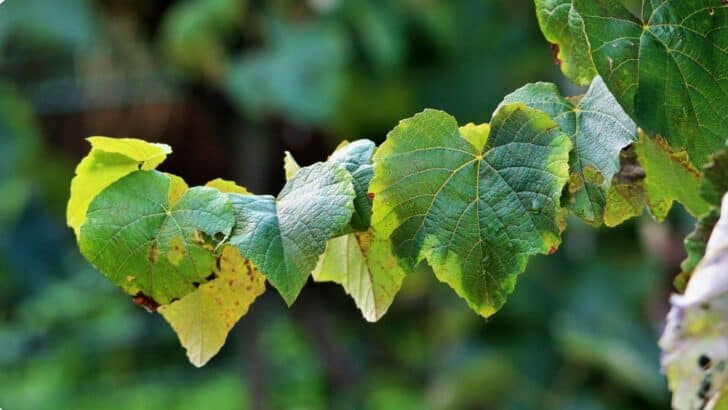
Wild grapes look much like their domestic cousins, growing in clusters along the long vines. They have tendrils, much like their domesticated cousins, that are used to climb up trees, shrubs, and whatever else they find in the environment around them.
They often grow along the edge of woods, streams, ponds, and in open clearings within the woods that receive enough sunlight. They particularly like wet, low-lying areas where they can easily climb into the surrounding trees.
The wild grape is easily identified in the fall by its fruit which is small, about the size of a blueberry, not a domestic grape, and is a dark purple almost black color.
The leaves of wild grapes appear very similar to their domestic cousins. The green surface of the leaf is smooth, it is lobed, heart-shaped at the base, with long, pointed tips that have serrated edges.
In the early summer, wild grapes have tiny white flowers that grow in clusters. These flowers turn into tiny, green unripe fruits that by fall turn into the small, blueberry-sized dark purple fruits previously mentioned.
Are there any poisonous wild grapes?
The common moonseed is the most prevalent wild grape look-alike and is toxic, even fatal if the leaves or fruits are ingested by humans.
However, upon close inspection, the common moonseed looks quite different from a wild grapevine. While they grow in similar areas within the wild, the moonseed does not get near as large, does not have any tendrils, is quite woody, and the edges of the leaves are not serrated.
Another quick way to differentiate between a wild grape and a common moonseed is to open up one of the fruits. Wild grapes contain two to four seeds within them. Moonseed fruits, on the other hand, only contain one, crescent-shaped seed, giving it its name.
Pokeberries appear similar to the wild grape, especially to children making it important to distinguish between the two especially if your children will be foraging with you.
Pokeweed, to an adult, doesn't look much like a wild grape at all. It has multiple red stems and when ripe the small fruits are a shiny purple color, not much resembling a grape. It also is not a vine, but grows along in the thicket like a grape and can appear vine-like to the untrained eye. Like the common moonseed, pokeweed doesn't grow as tall as a wild grape. While they can grow up to 20 feet, most never make it past 4 to 12 feet.
Another look-alike is the porcelain berry. It is not poisonous, but it's also not particularly palatable. While in the grape family it is a non-native invasive plant. It does not grow as large as most wild grapes, only reaching 15 to 20 feet. The berries are typically speckled, not looking much like a wild grape upon closer inspection.
The easiest way to identify a porcelain berry from a wild grape is the stem pith which is white and the bark has small, typically white, spots on it and will not peel.
Wild Grape Season

For fruit-picking, the best time is a fairly small window of time in early to mid-fall. You'll want to pick the fruits when the majority of them are that dark-purple color with very few, if any, green fruits on the vine.
You also need to pick them before the fruits begin to shrivel and decay. As I mentioned, the window for wild grape fruits is pretty small. Typically, in our northern Indiana location, we find plenty ready for picking around the autumnal equinox, making it a great autumn activity to celebrate the harvest.
What To Do With Wild Grapes

Wild grapes can be eaten off the vine, just like their domestic cousins. However, they're much tarter than domesticated grapes and probably won't be your favorite variety for fresh eating.
Wild grapes are excellent for making homemade grape juice, grape jam or grape jelly, and even homemade grape wine.
If you're going to press the grapes to get the juice out, be sure not to use your bare hands. Wear gloves or use a glass or something similar. The reason is wild grapes can be quite high in tartaric acid which can cause skin irritation ranging from mild itchiness to pain and even minimal burns.


Leave a Reply